Coconut Directives and Learning Page
- Identification of Palm Tree Parts
- Maintenance of the Coconut Trees
- Fertilizing of coconut Trees
- Pest Control of Coconut Trees
Coconut is one of the country’s natural benefactions. The Philippines is known as the world’s 2nd biggest producer of coconuts and the biggest exporter of coconut products. The coconut is a very beneficial fruit. It is the tree of life.
Identification of Palm Tree Parts


Maintenance of the Coconut Trees
Benefits of Pruning Coconut Trees
The tree will obtains higher yields and better growth characters of the intercrops resulting in a cropping system with higher efficiency and farm productivity.
Pruning coconut palm trees promotes vigorous growth and helps maintain its shape. Regular trimming encourages healthy branching, decreases wind resistance, and prevents potential safety hazards from falling fronds.
- It minimizes the adverse effects of drought on fruit sets
- It serves as a mechanical control measure for damages caused by pests and diseases on lower and older leaves.
- It helps the local containment of pests and diseases.
- It keeps the weeds, climbers, crawlers, and stranglers in check,
- Cut off dried leaves or
- Dead leaves or diseased leaves.
- Regular cleaning of the palm basins
- Unproductive palms that show a declining yield of more than 20 nuts per palm per year despite appropriate management practices should be replaced with the recommended high yielding varieties.
- Must keep the soil covered with mulch and remove weeds within the circumference of the canopy to a maximum 2 m around the trunk,
Our Classification for Maintenance
We will implement two sets of LISTS.
- The first list will be for the general assessment of each SECTOR,
- This is the GAL, General Assessment List
- This list will give us the amount of good, dead, or to be treated CNT or FT in a sector. This is to update our EXCEL files in the office.
- We can document all sectors continuously, do not start each sector with a new sheet.
- The second list will be for specific assessment of each TREE.
- This is the STL, Specific Treatment List
- This list will provide needed treatment and follow ups. This list is primarily for the team in the field to follow up with the SPECIFIC TREES: Investigate, treat, and monitor.
- Document each sector separately, start every sector with a new sheet.
Definitions
- Sector, is the sector according to our coded list
- Row #, is the row number of the section
- Tree, are the trees according to our coded list
- Missing, trees that should be planted or we missed planting them
- There are no more missing trees. They should have been registered and replaced by now.
- Replace, trees that are deformed or damaged, not growing, dead trees, showing weakness with seedlings of the same age. Or they are eaten by termites, or rotten.
- Treatment, trees that are sick with fungus or insects or do not have enough nutrients. They need treatments but could be saved.
- Good, growing well and producing harvest within expected range.
- Cause, the reason for being sick or not developing as well as the rest.
- What to do?, replant the tree, use Karate, use rat traps or anything else that was done.
General Assessment List
Download GAL here
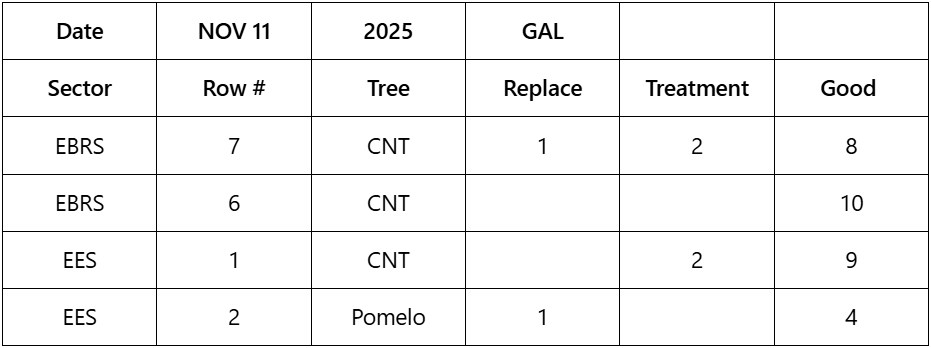
All trees that need treatment shall be marked separately for follow ups! In our example above we read:
- EBRS R7 CNT 1, 2, and 8. This is the GENERAL ASSESSMENT of row 7 for Coconuts, and so on.
This above report is a continues report sheet that marks down ALL Trees in their general conditions in that row of this sector.
- East Barangay Road Section, Row 7: 1 coconut to be replaced, 2 coconuts in treatment, and 8 good coconut trees.
Then we have a sheet for specifics. Here we break down each tree that needs replacement or treatment for follow up purposes.
Specific Treatment List
Example 1
Download STL here
Example 2
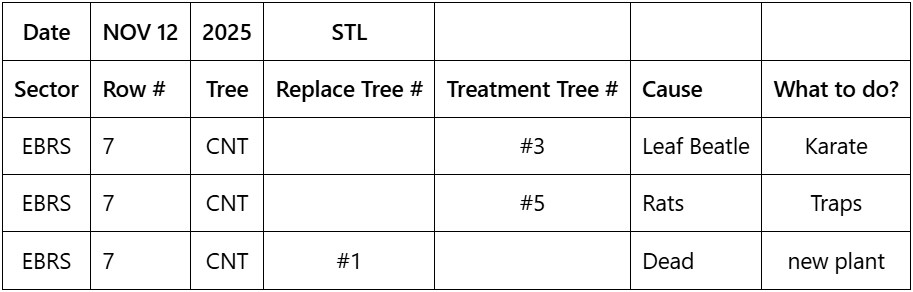
- EBRS R7 Treatment for CNT #3, is specific; CAUSE: Leaf Beatle, do Karate
- EBRS R7 Treatment for CNT #5, is specific; CAUSE: rats, do Traps
- EBRS R7 Replace CNT #1, is specific; CAUSE: dead, do new plant
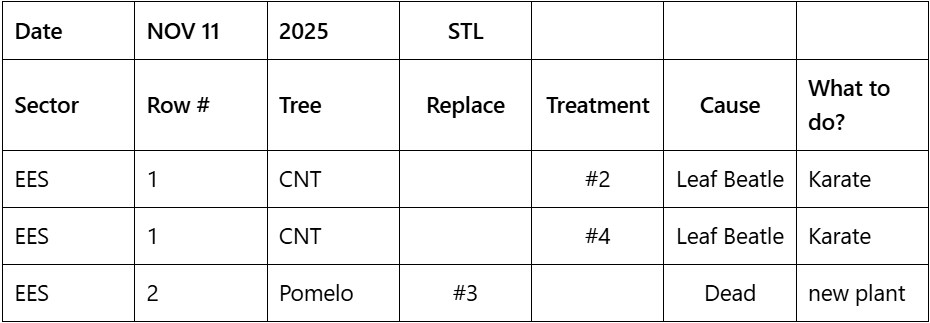
- EES R 1 Treatment for CNT #2, is specific; CAUSE: mealy bugs, do Karate
- EES R 1 Treatment for CNT #4, is specific; CAUSE: mealy bugs, do Karate
- EES R 2 Treatment for Pomelo #3, is specific; CAUSE: dead, do new plant
All sheets shall be dated and placed into a binder for a weekly follow up. Follow ups shall be commenced a week after the first treatment. Record the date of follow up and write down if the cause go worse, is the same, or got better. Repeat until the issue is resolved, by either replanting or declared healthy. Later this will be transferred into a electronic data set.
General Pruning Directions
- “Leave Ranking“, [LR] refers to the number of young, healthy leaves left on the tree after pruning to maintain its productivity and overall health. Pruning involves removing older, lower leaves to improve intercropping, and leave ranking helps ensure the tree has sufficient leaves for photosynthesis and nutrient uptake. Leaf Rank: Coconut leaves are numbered from the trunk with the youngest leaves at the top (#1) of the canopy, and oldest at the bottom, sometimes hanging, e.g. (#24).
- Pruning: A common practice is to prune leaves from the lower ranks (e.g., leaf rank 19) to improve sunlight penetration for intercrops or to remove unproductive leave
- Leaves Supporting Harvestable Bunches. Allow about 0.75 m of leaf fronds attached to the trunk to support the maturing nuts /bunches, if any!!
- Typically, maintain 18 younger leaves on the upper crown region.
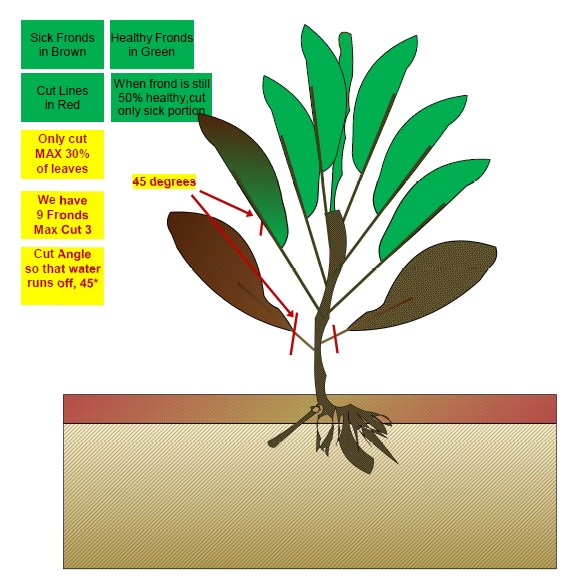
- Typically, no more than one-third of the fronds should be removed at a time. 2 out of 6 or 4 out of 12, or 4 out of 14, but 5 out of 15.
- Old, Yellowing, or Dead Leaves: Remove these leaves from the lower part of the crown as they are no longer contributing to the tree’s health and vigor.
- Leaves from LR 19 or 23: Pruning from these ranks can impact nut yield, with pruning from LR 23 resulting in a smaller yield reduction (10-15%) than pruning from LR 19.
How to Prune Coconut Tree
- Inspect Fronds (LEAVES) for Pruning. Evaluate common coconut palm for pruning by inspecting the fronds. Look for dead, weak, and diseased fronds. These are typically discolored, drooping, or have visible signs of damage or disease.
- Sterilize Pruning Tools. Prepare the necessary tools for pruning common coconut palm. Use a sharp, clean pruning saw or pole saw for high fronds. Ensure your tools are sterilized to prevent spreading disease.
- Wear Protective Pruning Gear. Wear protective gear before starting to prune common coconut palm. This includes safety glasses, gloves, and sturdy shoes. Fronds can be heavy and sharp, posing a risk when falling.
- Plan Pruning Cuts. Plan your cuts. Dead fronds will appear brown and hang downwards below the horizontal plane of the coconut’s canopy. Weak fronds may look yellowish and lack structural integrity, while diseased fronds will show abnormal spots, lesions or rot
- Remove Dead and Weak Fronds. Begin pruning common coconut palm by removing dead fronds. Cut each frond close to the trunk but do not damage the trunk or adjacent healthy fronds. Make the cut at a slight angle to prevent water accumulation on the stump which can lead to rot.
- Eliminate Diseased Fronds. Remove the diseased fronds from the palm. Be especially careful to prevent the spread of disease. Consider using a disinfectant on the tool between cuts if the disease is contagious.
- Dispose of Removed Fronds Safely. Dispose of the removed fronds from the trees properly as they can harbor pests or disease. Do not compost if they are diseased; instead, pile them in one area and we burn them later.
- Inspect Post-Pruning Canopy Balance. Inspect common coconut palm after all pruning is complete. Ensure that the canopy still appears balanced and that sufficient green fronds remain to sustain the health of common coconut palm.
- Clean and Sterilize Pruning Tools. Clean and sterilize all tools used on the palm to prevent the spread of disease to other plants. Store them in a dry place to maintain their sharpness and longevity.
- Regular Pruning Inspections. Once a month we inspect coconut trees for pruning needs to maintain health and vigor. Properly timed pruning helps prevent the need for more drastic measures in the future.
Fertilizing of coconut Trees
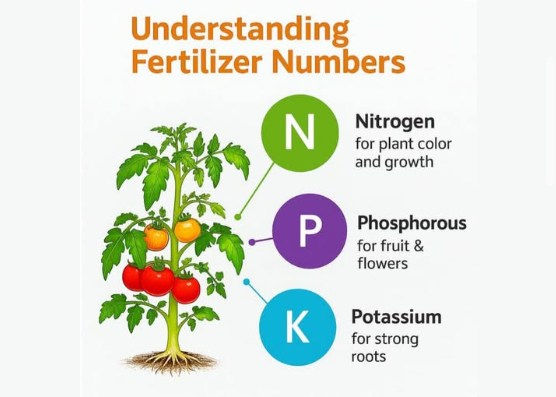
Fertilizing coconut trees is essential for maintaining strong growth, high nut production, and long-term orchard health. Coconuts are heavy nutrient feeders, especially needing potassium, chlorine, sulfur, and nitrogen to support vigorous frond development and consistent flowering. In many Philippine soils, especially older, weathered, or repeatedly farmed areas, natural nutrient levels are not enough to sustain optimum yields. Proper fertilization improves nut size, copra content, sugar water quality, and overall tree resilience against drought and pests. Regular nutrient replenishment also supports stronger root systems and prolongs the productive lifespan of the palms. In short, balanced fertilization keeps coconuts healthy, productive, and profitable.
Jessie’s Sunshine Farm will apply a 1/3 of a one year ration, every 4 months, three time a year. Fertilizer will be applied at canopy distance of the trees to a maximum of 2 meter distance in a circle around the palm tree.
Fertilizer Application per Trees
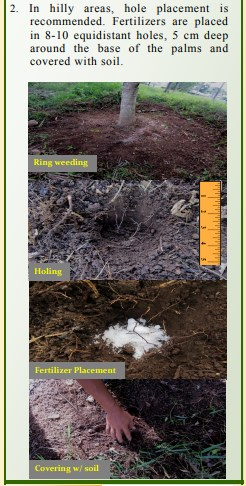
When we apply fertilizer we dig 8 holes as equal distance to each other in a ring around the tree. The distance from the tree is determined by the radius of the the crown. Each hole should be 5 cm or 2 inches deep. Pour in fertilizer and cover it with soil so that it cannot be carried away by rain and wind.
For further reading:

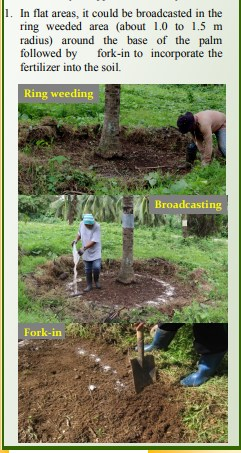
In flat terrain, upper farm
In slopy areas, lower farm
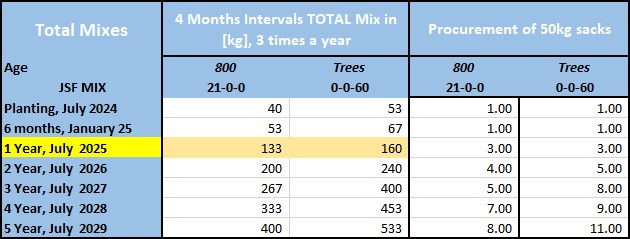
The Whole Farm Mixture is for 800 trees of Jessie’s Sunshine Farm. We pick the year in the left column and we can read in the next column to the right, how much 21-0-0 and 0-0-60 in kg, we will have to mix. But since we cannot buy half or quarter sacks, we have to procure rounded up or down quantities. This means under Procurement you will see how many sacks to buy for each of our 3 times (every 4 months) of fertilization per year. Therefore, we still have to mix the recommended kg in the first columns. We consider all trees now one year old, as of July 2025.
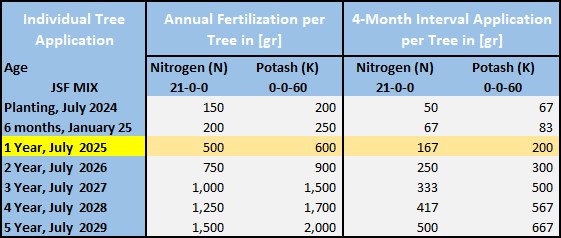
Under Single Tree Mixture we have the dose per tree. We prepare a container for the combined doses in the very right columns, 4-Months Interval Application. We add 21-0-0 and 0-0-60, fill it into the container. Now we have a constant volume to apply per tree.
Whole Farm Mixture
Single Tree Mixture
Pest Control of Coconut Trees
Stages of Infestation
Early stage
Starts with yellowing of lowermost leaves.
Severe stage
Almost all leaves are dried up leaving only the youngest leaf green.
Recovering stage
New green leaves are produced with at least 6-7 new green leaves with emerging inflorescence. Inflorescence are the complete flower head of a plant including stems, stalks, bracts, and flowers
Cocolisap Scale Insect
Cocolisap, or the coconut scale insect (CSI), is a significant pest of coconut trees that causes damage by feeding on the sap. The CSI, known scientifically as Aspidiotus rigidus in some areas, is a small, flat, yellowish scale insect with a waxy covering. It can cause yellowing and wilting of leaves, premature nut fall, and reduced yields.
Nature of Damage
Cocolisap is the common name for the Coconut Scale Insect (CSI), an insect that feeds on the sap of coconut palms. Cocolisap feeds on the leaves of young palms and on the surface of fruits that result in the yellowing and wilting of leaves, till the entire coconut tree dies. It prevents photosynthesis, causing premature nut fall and low productivity. The cocolisap attacks the coconut tree by eating the leaves, fruits, and flowers until only the trunk is left.
Controls and Mitigation:
- Mechanical – Selective coconut leaf pruning – removal of affected coconut fronds to reduce the CSI pest population.
- Chemical – Trunk injection with chemical or botanical pesticides – use of systemic insecticides.
- Biological – Control agents (predators and parasitoids).
- https://agritech.tnau.ac.in/crop_protection/crop_prot_crop_insect_oil_coconut.html#13
Further Reading and Details
Cocolisap Scale Insect Identification


Coconut Leaf Beatle
The coconut leaf beetle, scientifically known as Brontispa longissima, is a significant pest of coconut and other palm trees. Both the larvae and adults of this beetle feed on the young, unopened leaves of palms, causing damage and potentially leading to death of the tree. The damage manifests as scorched, ragged leaves with brown blotches.
Nature of Damage
The beetle attacks palms of all ages, but young palms are more susceptible than older
ones, because the heart leaves of old palms are firmer and less suitable as breeding grounds for the beetle. Larvae of the beetle chew on large areas of the surface of leaflets still in the throat of the palm (the spear leaf), which causes the death of underlying tissues. Such leaflets show longitudinal white streaks. As the leaf emerges, the leaflets curl and turn brown,
giving a characteristic scorched and ragged appearance. Photosynthesis is reduced to zero in affected leaflets. As the spear
unfurls, the beetle moves on to other palms or the next emerging spear. The beetle does not attack leaves that emerge undamaged.
The coconut leaf beetle spreads mostly through the movement of infested palms. Its natural spread is very slow since the beetles cannot fly long distances.
For further Reading and more Detail:
Coconut Leaf Beatle Identification


Controls and Mitigation:
- Mechanical – The pest is mostly controlled by pruning, clean culture and proper disposal of infested coconut palms and parts thereof.
- Chemical – Several insecticides including imidacloprid, dieldrin, aldrin, phosdrin, aldicarb, dichlorvos, fenthion, diazinon, azinophos, methidathion and chlordane are being used to control the coconut leaf beetle.
- Some insecticides are also injected into the trunk of infested palms. However, the effect of these treatments lasts only for 3-4 months.
- Hanging insecticide bags on infested palms has been attempted successfully to check the spread of the beetle.
- Biological– Natural predators include shield bugs, ladybirds, wasps, spiders and tachinid flies. Entomopathogens, microorganisms that invade and reproduce in an insect and spread to infect and hence kill other insects.
- Spraying of coconut crown of young palms with entomopathogens.
Control Bugs:


Rhinoceros Beetle
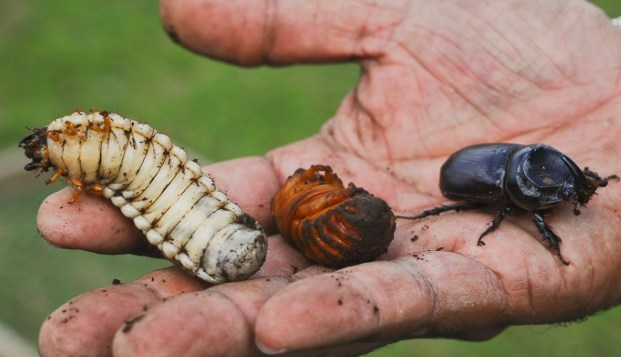
The coconut rhinoceros beetle (CRB), (Oryctes rhinoceros L.), causes significant damage to coconut palms by tunneling into the crowns and feeding on developing leaves and sap. This damage leads to a variety of problems, including reduced nut production, wilted fronds, and potentially the death of the palm tree.
- Rhinoceros beetle is the most prevalent pest of the coconut palm
- The abundance of breeding areas allows rapid population increase
- Adults are the destructive stage
Nature of Damage
- Reduced nut production: Fewer leaves mean less energy for the palm to produce nuts.
- Wilted fronds: The beetles’ tunneling can damage the tissue, causing fronds to wilt.
- Death of young palms: Heavy infestations can kill young, developing palms by destroying their growing point.
- Death of mature palms: Extreme damage can also lead to the death of mature palms.
- As the fronds grow and unfold, the damage appears as V-shaped cuts or missing areas, particularly in the leaflets.
- Flowers dying: The beetles can damage the flowers as well, leading to their death.
- Early nut fall: Damage can cause nuts to fall prematurely.
Rhinoceros Beetle Identification


Controls and Mitigation
Mechanical :
- Manually extract and destroy adults: A hooked wire can be used to remove adult beetles from palm crowns.
- Remove dead palms: Remove dead palms promptly to prevent them from becoming breeding sites.
- Avoid introducing new potential breeding material: Be cautious about bringing in new mulch, compost, or other organic materials that could be infested.
- Maintain good sanitation practices: Regularly clean up and remove debris from around palms and other plants.
- Remove and destroy breeding sites: Rhinoceros beetles breed in decaying organic matter. This includes cutting and burning dead coconut trees, removing stumps as close to the soil as possible, and properly managing compost and manure piles.
- Cover potential breeding sites: If you can’t eliminate breeding sites, you can cover them with vines or ground cover to discourage beetles from laying eggs.
- Regularly turn compost piles: This helps to decompose organic matter faster and reduces the time available for rhinoceros beetles to develop.
- Compost and manure management: Properly manage compost piles by turning them regularly and removing any beetles found. Similarly, manage manure pits and avoid piling excess material.
Biological
- Green Muscardine Fungus (GMF):The fungus can be used to inoculate coconut logs or other breeding sites, helping to control the beetle population.
- Oryctes virus: This virus can also be used to control the beetle population, especially in breeding sites.
Chemical:
- Pheromone traps: These traps use a chemical lure (pheromones) to attract adult beetles, which then become trapped and are unable to escape.
- Light traps: These traps use light to attract beetles, which are then captured and killed.
- Systemic insecticides: Treating palms with systemic insecticides can help protect them from rhinoceros beetle damage.
- Naphthalene balls: Naphthalene balls can be placed in the leaf axils of young palms as a preventative measure.
For further reading and more details:
Nature of Damage


Control and Mitigation


Palm Weevil
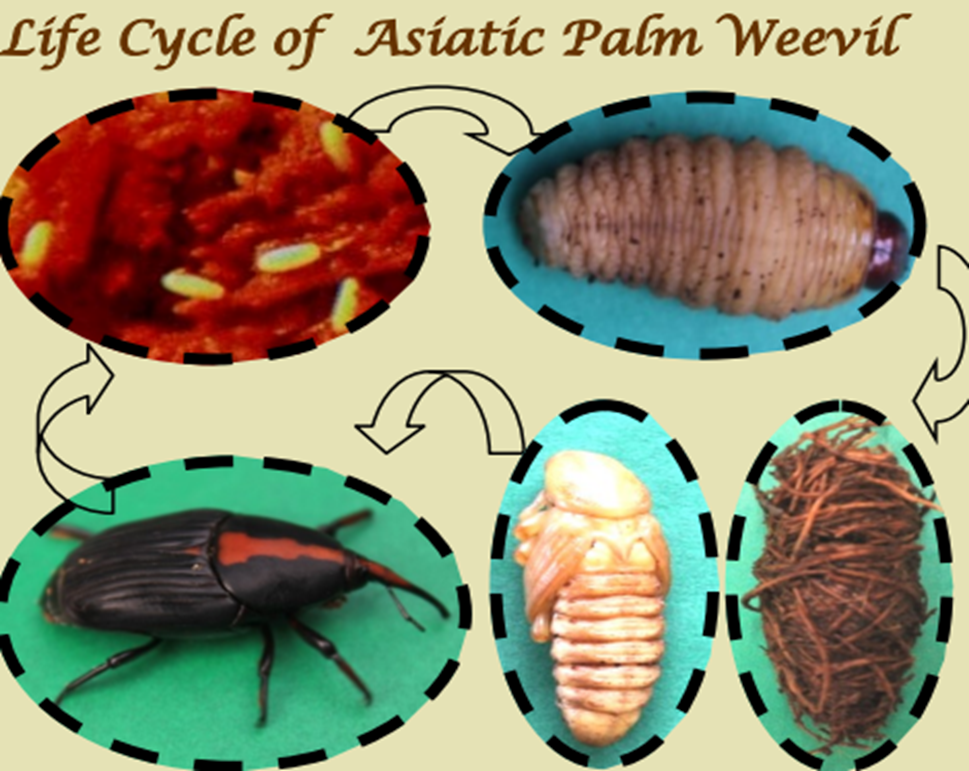
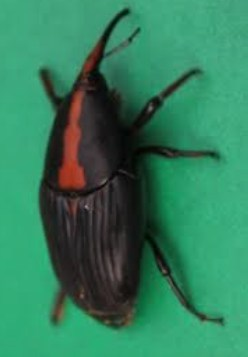
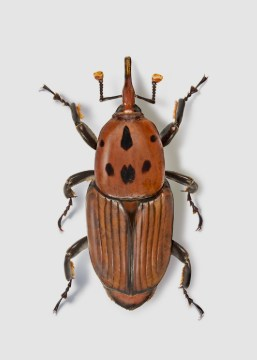
Asiatic Palm Weevil, and so is the Red Palm Weevil, is a lethal pest of coconut and 30 other plant species. Infest 5-20 years old, when the trunk tissues are still soft and succulent
Asiatic Palm Weevil and Identification
- Mated female deposits eggs by scooping small holes on wounds on trunk or fronds.
- After hatching, larva bores deeply into the trunk and spends its entire life cycle inside.
- Larvae and adults continuously chewed on the inside of the trunk.
- The feeding can reach the growing point and kill the palm.
- Infestation that started on the base of trunk can result to toppling and death of palm.
Nature of Damage
Visual symptom level of Red Palm Weevil infestation in Oil Palm (or Coconuts) seedlings based on empirical observations in this greenhouse experiment.
- (A,B) Level 1 infestation observed between first to the third week: no symptoms visible especially at the sealed crown base.
- (C,D) Level 2 infestation observed between fourth to sixth week: dark oozes and smelly sap together with soft, creamy-coloured tissue appeared at the crown base; brown sawdust recorded between the plantling’s trunk and the base of the leaves.
- (E–G) Level 3 infestation observed between sixth to ninth week: host plant’s shoot started to lean to the ground; the leaves started to fall; loss of symmetry at palm upper crown.
- (H,I) Level 4 infestation observed at the ninth week: leaves collapsed and started to show skirting shape; shoot was dried out and fell off.
For further Reading and more Details:
Palm Weevil Identification
Asiatic Palm Weevil
Red Palm Weevil
Controls and Mitigation
- Farm Sanitation Disposal of all plant parts of palm infested with APW or RPW
- Pheromone Trapping
- Commercial palm weevil lures is used at a rate of one trap for every 1-2 ha. Lure is placed in store bought or fabricated pail that have small windows and rough outside surface. Trapping is enhanced with the addition of food baits.
- Avoid wounding the trunk
- Implementation of quarantine measure
- Preventive spraying of trunks to deter egg laying


Coconut Mealy Bug
The Coconut Mealy Bug, Nipaecoccus nipae, is a sap-sucking insect that infests various plants, including coconut palms. It causes damage by feeding on the plant’s sap, producing honeydew, and potentially leading to sooty mold growth.
Nature of Damage
- Adult females and immatures feed on the sap of the host plant and secrete honeydew, which promotes black sooty mold growth and attracts ants.
- Ants defend the mealybugs from predators or parasitoids
- Black sooty mold can reduce photosynthesis and cause defoliation, and occasional death of a young plant.
Controls and Mitigation
Mechanical
- Dislodge mealybugs with pressurized water sprays.
- Use horticultural oils and soaps against mealybugs (contact, no residual effect).
Chemical
- Carefully select insecticides that will not kill beneficial insects (lady beetles, green lacewings, parasitic wasps).
- Use effective systemic insecticides (imidacloprid, dinotefuran, acetamiprid, spirotetramat or IGR pesticides containing buprofezin) in chemical rotations against mealybugs.
Further Reading and more Details:
Biological
- Nematodes: Nematodes, particularly those like Steinernema feltiae, can be applied to wood or soil near termite colonies, where they seek out and destroy termites. Applicators have reported effectiveness ranging from 50 to 95 percent, and they can survive for up to two years.
- Entomopathogenic Fungi: Certain fungi, like Metarhizium anisopliae, can be used to infect and kill termites. Their spores can be sprayed directly onto timber or into termite-infested wood, providing protection for a period of time, according to a report from ICUP.
- Ants: Ants, especially those that are opportunistic predators of termites, can play a role in suppressing termite populations. Some studies have shown that certain ant species can exclude termites from occupying feeding sites at the soil surface.
Coconut Mealy Bug Identification


Coconut Termites
Coconut Termites, particularly species like Neotermes, can be a significant threat to coconut palms, especially young trees in nurseries or those recently transplanted. These termites can damage the tree by tunneling and hollow out the trunk, eventually leading to the tree’s death. They often construct tunnels from soil hills to the palm, feeding on all parts of the young tree.
Nature of Damage
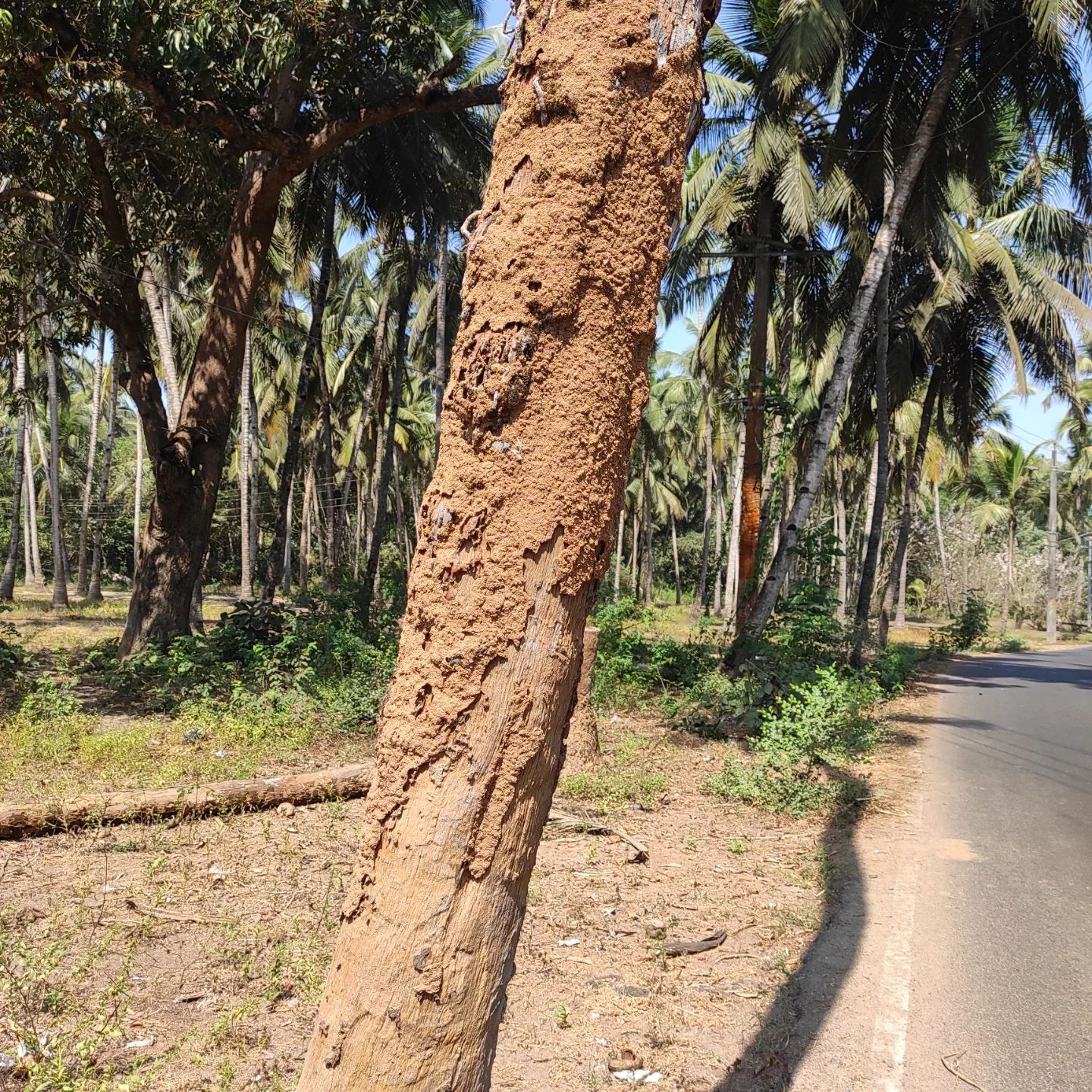
- The termites hollow out living trunks, leading to the top of the palm snapping off, even in the relatively low force of the trade winds. The yield of young palms may also be reduced, and they may be killed before they bear coconuts. The termite workers make holes and grooves on the surface of coconuts that are characteristic of Neotermes rainbowi and unlike other species; later, these form a net-like pattern from soil level to several metres. The grooves, which extend to the depth of the bark are covered with chips of wood and bark mixed with faecal matter.
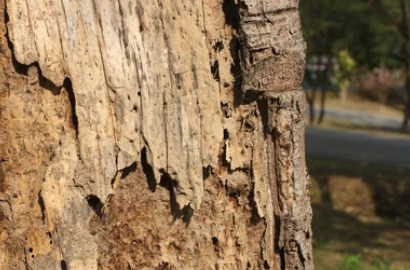
- The insides of the trunk are also attacked, and the hollowing out that occurs leads to the tops of the palms breaking off. In some places the termites spread from the infestation through roots and soil to neighboring palms.
- Look for the net-like grooves covered with a mix of wood and fecal matter within the bark of coconuts; these channels are characteristic for the species. Look for hollowed out stumps.
Termite Identification


Controls and Mitigation
Chemical
- In general, insecticides are not recommended and should not be used, especially where contamination of the water table is a possibility.
- Selected strains of Metarhizium anisopliae and an entomopathogenic nematode, Heterorhabditis sp. have been tried in Tuvalu by injecting them into termite nests and have given promising results.
Further Reading and more Details:
Mechanical
- Remove and burn infested coconuts palms as soon as the telltale net-like grooves are seen on the bark.
Slug Caterpillar

Nature of Damage
Slug caterpillars are voracious eaters and their feeding can rapidly decimate a plant or crop.
- Leaf Consumption: They chew ragged holes in leaves, often consuming large amounts of plant tissue, sometimes leaving only the mid-rib or major veins intact (skeletonization).
- Crop Loss: In agricultural settings (e.g., oil palms, cocoa), this loss of leaves hinders photosynthesis, leading to reduced yields and potential plant dieback.
- Aesthetic Damage: Besides direct consumption, they spoil plants with significant amounts of frass (excrement).


Slug Caterpillar Identification
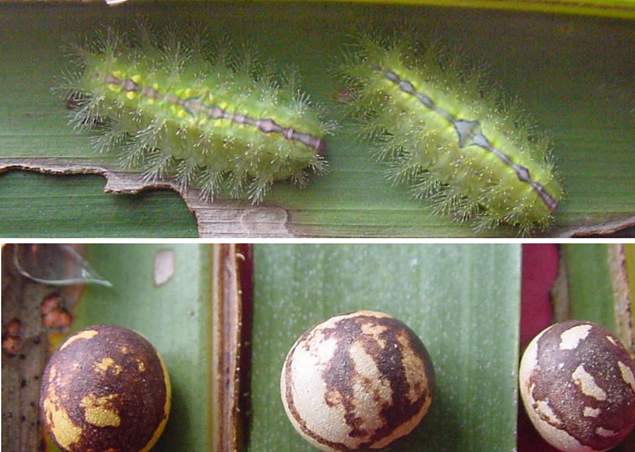
Slug Caterpillar, Parasa lepida and Contheyla rotunda
- Egg: Flat shiny eggs on the under surface of leaves
- Larva: Greenish body with white lines and four rows of spiny scoli tipped red or black, which cause irritation and pain.
- Pupa: It pupates in a compact elliptical chocolate brown shell like cocoon, which is convex above and flat ventrally as stems. Cocoons are covered with irritating spines and hairs
- Adult: Adult moth has green wings with prominent dark patch at the base of each forewing.

Controls and Mitigation
Mechanical:
Set up light traps to trap and collect adult moths. About 5 light traps may be installed per hectare.
For Further Reading and more Details:
Chemical:
- Collect and destroy the immature stages of the insects by conducting study (or neem campaign) wherever possible and spray carbaryl 50 WP 2 gm/lit .
- Spray carbaryl 50 WP 2 g/l.
- Spray dichlorvos 76 WSC 2 ml / lit.
More useful Links for Insects

- Coconut (false) scale (348)
- Coconut Aspergillus mould (233)
- Coconut basal trunk rot (484)
- Coconut Bogia disease (229)
- Coconut bud rot (140)
- Coconut embryo rot (070)
- Coconut false smut (311)
- Coconut Finschhafen disorder (280)
- Coconut flat moth (065)
- Coconut foliar decay (231)
- Coconut hispine beetle (059)
- Coconut leaf spots (090)
- Coconut leaf stripe (139)
- Coconut leafminer (060)
- Coconut mealybug (347)
- Coconut red palm weevil (180)
- Coconut rhinoceros beetle – Melanesian (057)
- Coconut rhinoceros beetle – Oryctes (108)
- Coconut scale (104)
- Coconut seedling basal stem break (069)
- Coconut seedling blight (075)
- Coconut sexava treehopper (246)
- Coconut spathe bug (062)
- Coconut spike moth (111)
- Coconut stick insect (102)
- Coconut termite (116)
- Coconut thread blight (167)
- Coconut tinangaja (198)
Disease Control of Coconut Trees
Major diseases found in coconuts are: Bud rot, Leaf rot, Stem Bleeding, Root (wilt) disease, Tanjavur wilt, Mahali, Crown chocking, Leaf blight or Grey Leaf Spot, Tatipaka Disease.